POV: your K-beauty parcel finally arrives, you’re doing a little happy dance at the door, and the courier goes “that’ll be €14, please.” 💀
Quick answer: Pick your country below and the checker tells you who collects the tax: the store at checkout, or the courier at your door. It also shows the amounts that are fixed by law. Rules last checked 20 October 2026 for the US, EU, UK, Canada and Australia.
I built this because the US and EU both changed their low-value import rules recently, and most older guides are now wrong. Unnie did the boring part so your happy dance can stay happy.
Lisa’s 17 looks, for courage before customs math
Customs rules are dry. BLACKPINK’s Lisa breaking down 17 of her looks for Vogue is not. Watch this, then do the checker:
Rules checked 20 October 2026. The United States and the European Union both changed their low-value import rules in the last 14 months, so most older guides are now wrong.
Almost every K-beauty price comparison stops at the sticker price. Then the parcel arrives and the courier sends a message asking for €14 before delivery. This page answers the question that actually decides whether an order is worth it: will you be charged at the door, and who collects it?
It does not guess your final total. Shipping changes by weight and promotion, and duty depends on the tariff code of each product. What does not change daily is the rule — whether a threshold still exists, who is legally required to collect, and what amount is fixed by law. That is what the checker below shows.
Check your parcel
Enter your country and what you are about to pay. This shows who collects the tax — the store at checkout, or the courier when the parcel arrives — and the amount where it is fixed by law.
Rules checked 20 October 2026 — the rules behind these numbers are written out further down this page.
US: the $800 de minimis exemption has been suspended for all countries since 29 August 2025, was written into CBP regulations on 24 June 2026, and is repealed by statute on 1 July 2027. No duty-free threshold remains.
EU: the €150 duty exemption ended on 1 July 2026; a flat €3 per tariff line applies to consignments up to €150 until 1 July 2028. VAT on those consignments is collected at checkout when the seller uses IOSS. Italy charges an extra handling fee, Romania another, and an EU-wide fee is under discussion.
UK: goods up to £135 have VAT collected by the seller at checkout; above £135 import VAT and duty apply.
Canada: courier de minimis CAD 40 (postal CAD 20); above that, duty plus GST/HST/PST by province.
Australia: GST is collected by the seller on orders up to AUD 1,000; above that, duty and GST at the border.
Verify your own case: CBP · European Commission · GOV.UK
The five rules, side by side
| Destination | Duty-free threshold | Who collects |
|---|---|---|
| United States | None. The $800 exemption has been suspended for every country since 29 Aug 2025 | The courier, unless the store ships DDP (duties included) |
| European Union | None since 1 Jul 2026. A flat €3 per product type applies up to €150 | VAT by the seller (if IOSS registered); the flat duty by the seller or importer |
| United Kingdom | £135 | The seller collects 20% VAT at checkout; above £135 the courier does |
| Canada | CAD 40 by courier, CAD 20 by post | The courier, plus a brokerage fee |
| Australia | AUD 1,000 | The seller collects 10% GST at checkout; above AUD 1,000 the border does |
Read the middle column as a promise, not a price. A threshold that still exists means you can plan. A threshold that has been removed means the only thing you can control is how the charge is collected — which is a choice you make at checkout, not at the door.
For the full dated timeline of what changed and when, see the country-by-country shipping and duties guide.
Three ways to avoid a surprise at the door
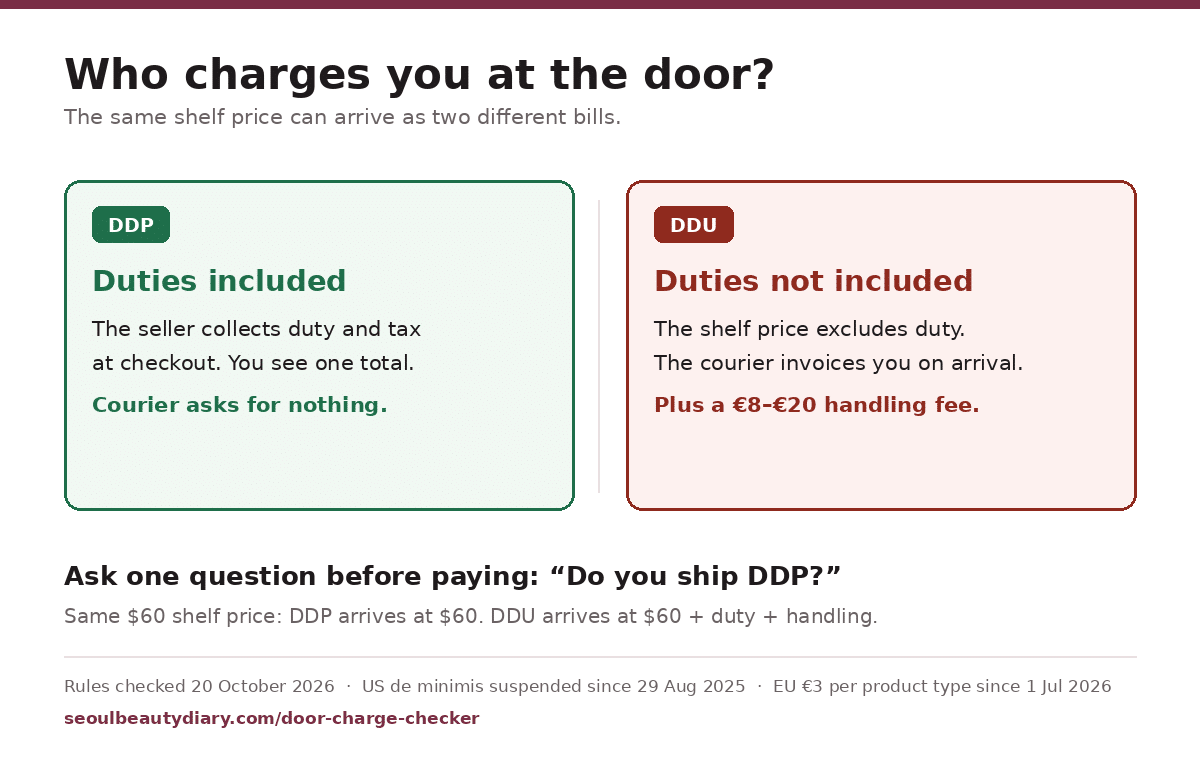
- Ask one question before paying: “Do you ship DDP?” DDP means duties are included in the price you see. DDU means the courier will invoice you separately. One sentence in a support chat prevents almost every door charge.
- Count your product types, not your items. Under the EU rule the €3 is charged per tariff line. Three lip tints are usually one line; a cleanser, a serum and a mascara are three.
- Do not split an order to dodge duty. Since the US exemption disappeared there is no threshold left to dodge, and split parcels simply multiply courier handling fees.
What this page does not tell you
Being precise about limits is more useful than pretending to know everything:
- Your exact shipping cost. It depends on weight, destination and the store’s current promotion. Check the cart.
- The duty rate on a specific SKU. That needs the tariff code and the country of origin. Most skincare and make-up sits under HS 3304, but the subheading is the part that decides the rate.
- The courier’s handling fee. DHL, UPS, FedEx and national post each charge their own, typically €8–€20 in the EU and similar in other markets.
Everything else — who collects, whether a threshold exists, and what is fixed by law — is in the checker above, dated.
Frequently asked questions
- Will I pay customs on a K-beauty order shipped to the US?
- Assume yes. The $800 duty-free exemption has been suspended for every country since 29 August 2025, so a commercial parcel of any value is now a customs entry. Whether the charge reaches you at the door or is already inside the checkout total depends on the store’s shipping terms — that is what the DDP question above is for.
- Is the $800 de minimis exemption coming back?
- No. It was suspended by executive order in 2025, written into CBP regulations in June 2026, and repealed by statute with effect from 1 July 2027. A court challenge in 2026 upheld the suspension.
- How much duty does the EU charge on a €60 parcel?
- For consignments up to €150, a flat €3 per product type since 1 July 2026. Two product types is €6. VAT is separate, and it should already be in the price if the seller uses IOSS.
- Do I pay VAT twice if the store already charged it?
- You should not. If the seller collected import VAT at checkout under IOSS, the courier should not collect it again. If you are charged twice, keep the checkout receipt — it is the document that gets the second charge refunded.
- What is DDP and why does it matter more than the price?
- Delivered Duty Paid means the seller handles the customs charge and the price you see is the price you pay. Under DDU the parcel is charged on arrival. Two stores can show the same shelf price and produce very different final costs, purely because of this.
- Will Stylevana, YesStyle or Olive Young charge me at the door?
- It depends on the shipping option you choose at checkout, not on the brand. Look for a line that says duties or import taxes are included. If the checkout shows no tax line at all, plan for the courier to collect on delivery.
- Does splitting my order help?
- Only in the UK (below £135), Canada (below CAD 40) and Australia (below AUD 1,000). In the US there is no threshold left, and in the EU the flat duty is per product type, so splitting usually adds handling fees rather than removing them.
- Are these rules the same for gifts?
- No. Genuine gifts have a lower allowance in most markets, and commercial parcels marked as gifts are the fastest way to have a delivery held. This page covers purchases only.
Where to go next
The rule is half the decision; the other half is which store actually ships it well.